Fraud and theft are estimated to cost illegal streaming viewers £270 million a year
According to WPI Economics, the annual financial losses suffered by UK users of illegal streaming services as a result of fraud, theft and identity theft amount to approximately £270 million. The research used a relatively narrow definition of financial harm, and its authors consider the figure a conservative estimate. Actual losses could therefore be even higher. Some respondents reported financial losses of up to £5,000. The study also cites earlier research that used a broader definition of financial fraud. According to that research, average losses could reach £1,680 per person.More than one-third of illegal streaming viewers have encountered harmful or inappropriate content
One of the most significant risks of illegal streaming is exposure to malware and unsafe websites. According to WPI Economics’ own survey, 37% of active users of illegal streams encountered harmful or unsafe content when accessing pirated sources. Among active illegal streaming viewers, 30% encountered malware, viruses or pop-up advertisements, while 11% encountered content they considered inappropriate. These groups may overlap. The authors note that a common tactic used by fraudsters is to trick users into installing malicious software. Such software can be used to steal login credentials, collect personal information or misuse payment details. The study also mentions banking Trojans, malicious programs designed to steal banking information. In this context, WPI Economics refers to earlier research conducted for the AAPA (Audiovisual Anti-Piracy Alliance) in 2022. That research found malware in 57% of the illegal streaming devices and IPTV applications examined. Another study by FACT and Webroot from the same year classified 90% of the illegal streaming websites examined as risky because of malware or inappropriate content. These figures are therefore not findings from WPI Economics’ own 2026 survey, but results drawn from previous research. A US study from 2023 also highlighted a possible connection between visits to piracy websites and identity theft. According to data cited in the UK report, 44% of people who had visited a piracy website experienced identity theft, compared with 10% of those who had not visited such sites. This substantial difference highlights the security risks associated with the piracy ecosystem, but it does not, in itself, prove that all the reported cases of identity theft were directly caused by visiting a piracy website.Illegal streaming can also lead to compromised user accounts
In addition to direct financial losses, users may also face compromised online accounts and loss of control over their personal data. The study describes, for example, the experience of a woman named Amelia, who began using unofficial streaming services and a modified Amazon Fire Stick to access a wider range of content at a lower price. After purchasing the device and subsequently using unofficial streaming websites, she experienced attempted fraudulent payments, compromised user accounts and a hack of her Facebook profile. Her experience illustrates that using illegal streaming sources can be associated not only with financial scams but also with threats to personal information and online accounts. Piracy services can therefore expose users to risks whose financial and other consequences may far outweigh the savings that originally led them to choose illegal content.UK consumers are estimated to spend £1.2 billion a year on pirated content
Illegal streaming certainly does not always mean that viewers access content for free. According to the WPI Economics survey, more than a quarter of active illegal streaming viewers pay to access pirated content — 28%, to be precise. The authors estimate that UK users spend approximately £1.2 billion annually in this way. According to the authors, this spending also has serious wider social consequences. The study warns that piracy services can be a source of funding for organised criminal groups involved in the illegal distribution of content. Viewers’ payments may therefore indirectly support other criminal activity. However, the estimate does not mean that the entire £1.2 billion automatically goes to organised crime. Links to organised crime may extend beyond payments for illegal services. Citing other specialist sources, the authors warn that malware installed in connection with pirated content can allow criminal groups to exploit users’ internet connections. Their IP addresses may then be used to conceal other illegal activities, including cyberattacks and financial fraud. The possibility of indirectly financing organised crime also surprised Amelia, whose experience is described in detail in the study. She said she had never associated paying for illegal streaming with supporting criminal activities. Had she known about this connection earlier, she said, she would not have watched content illegally. Her reaction suggests that awareness of the wider consequences of piracy may be an important motivation for some viewers to change their behaviour.More than half of illegal streaming viewers expect to continue pirating content
Despite the numerous risks associated with illegal streaming services, reducing their use may not be straightforward. According to the survey, 52% of active illegal streaming viewers expect to continue accessing pirated content. The study’s authors therefore stress that existing efforts to curb the illegal distribution of content need to be complemented by measures aimed at users themselves and at improving their awareness. Rights holders and other stakeholders already spend tens of millions of pounds each year on anti-piracy measures. The study also refers to existing UK legislation, particularly the Copyright, Designs and Patents Act 1988 and the Digital Economy Act 2017. According to the authors, the powers provided by these laws focus primarily on restricting the supply of pirated content and prosecuting those who distribute it illegally. However, limited consumer awareness of the security risks of illegal streaming remains a problem. The research also suggests that change is possible. If a strategy were implemented that made illegal content harder to access and emphasised the associated risks, 34% of active illegal streaming viewers said they would be likely to stop using pirated sources. However, this is a stated intention among respondents, not an observed reduction in piracy following the introduction of specific measures.How can piracy be reduced? Public awareness and cooperation with technology platforms are essential
The study’s authors propose two main approaches. The first is reducing demand for illegal services by improving consumer awareness. The second is limiting the availability and visibility of pirated content. According to the authors, both approaches should form part of coordinated cooperation among public authorities, broadcasters, rights holders, technology platforms and internet service providers. In terms of public awareness, they recommend greater involvement by the UK government in information campaigns highlighting financial scams, data theft and other cyber risks. One specific option they mention is supporting the existing BeStreamWise initiative, which focuses on the dangers of illegal streaming. According to the study, its focus is also consistent with the aims of the UK government’s Stop! Think Fraud campaign, which is dedicated to fraud prevention. The authors argue that using official government communication channels could help reach a broader range of consumers. The second area is cooperation among organisations that can influence the spread of illegal content. The authors recommend establishing a voluntary cross-industry framework setting out shared principles for technology platforms, internet service providers and content services. Such a framework should recognise the differing capabilities and responsibilities of individual stakeholders and enable coordinated, proportionate anti-piracy measures. The study also identifies three specific areas for potential cooperation. The first is more effective action against repeat infringers, particularly those who continue illegally distributing content after previous interventions. The second concerns using existing technologies to detect pirated content and restrict access to it. The third is greater transparency and responsible sharing of aggregated data on how illegal services are used and on emerging trends. The aim is to better understand how piracy is evolving and coordinate more effective responses.Warnings about copyright infringement alone may not be enough
The UK study’s findings show that illegal streaming is not solely a problem for television companies, film producers or sports organisations. Viewers themselves also face risks, potentially losing money, personal information or control over their online accounts. Some of the money spent on piracy services may also support organised crime. According to the authors, this personal dimension could be an important argument in efforts to reduce piracy. Highlighting financial and cybersecurity risks while making illegal content harder to access could help change viewing behaviour. The study therefore suggests that protecting consumers themselves may play a significant role alongside protecting copyright. About the study: The report The Price of Piracy: Hidden Costs of Illegal Streaming to the UK Economy was prepared by UK consultancy WPI Economics in association with the BeStreamWise initiative. It examines the scale and nature of illegal streaming of films, TV shows and sports broadcasts in the United Kingdom, its economic impact, the risks to viewers and possible ways to curb digital piracy. Among other sources, the study draws on a survey of 2,501 respondents conducted by JL Partners between 3 and 11 February 2026. In addition to the survey findings, it uses other statistical and specialist sources, as well as its own economic models, to estimate the financial and wider economic impacts of piracy. Source: The Price of Piracy – WPI Economics, 2026Bosnia and Herzegovina’s cable operators and audiovisual rights representatives are seeking faster removal of online advertisements promoting illegal IPTV services.
The Association of Cable Operators and Distributors of Network Services (AKOP BiH) and the Association for the Protection of Audiovisual Works (APAW BiH) met representatives of online platforms and the advertising sector to discuss clearer reporting and removal procedures.
The initiative aims to restrict the promotion and sale of services offering unauthorised access to television channels and other audiovisual content. The associations say these services damage rights holders and licensed distributors.
“It is equally important to restrict the channels through which they reach users, and online advertising is one of them,”
AKOP BiH said in translated comments.
Discussions also covered how illegal IPTV systems operate, the role of online intermediaries and handling complaints in the context of Bosnian and EU rules and practice.
The announcement does not identify the participating platforms or set a timetable for introducing the proposed procedures.
Source: broadbandtvnews.com Illegal streaming of films, TV programmes and live sports costs the UK broadcasting industry an estimated £1.35 billion in lost revenue every year, according to a new study. But the consequences extend far beyond broadcasters. Economic modelling suggests that these revenue losses are equivalent to more than 10,000 jobs and £366 million in lost tax revenue. The money lost to piracy could otherwise help fund new films, television series, production studios and sports development. The economic impact of digital piracy is examined in the UK study The Price of Piracy: Hidden Costs of Illegal Streaming to the UK Economy. Its authors emphasise that illegal streaming does more than deprive broadcasters and broadcasting rights holders of revenue. It also reduces the funds potentially available for producing new content, developing the audiovisual industry and supporting sport. As a result, the economic consequences of piracy can affect a wide range of other sectors.Film, Television and Sport Are Major Contributors to the UK Economy
The potential scale of these effects becomes clear when considering the economic importance of both industries. In 2024, UK film and television production generated £23.5 billion in gross value added (GVA), while the sports industry contributed £20.6 billion. Film and television production employed approximately 250,000 people, with a further 560,000 working in sport. Together, these industries supported more than 800,000 jobs. The importance of the UK film and television industry is also reflected in production investment. In 2025, spending on film and high-end television (HETV) production reached £6.8 billion. Inward investment productions accounted for 85% of total expenditure, approximately £5.8 billion. The UK therefore remains a major international hub for audiovisual production, whose continued growth also depends on access to investment funding.Piracy Costs UK Broadcasters £1.35 Billion in Lost Revenue Every Year
According to economic estimates by WPI Economics, the UK broadcasting industry loses approximately £1.35 billion annually due to illegal streaming. Of this amount, £700 million is attributed to the illegal streaming of live sports, while a further £653 million relates to films and television programmes. The estimated direct revenue losses are therefore substantial in both categories. The study’s authors point out that these figures represent estimated lost revenue for the broadcasting industry rather than a comprehensive assessment of all the economic consequences of piracy. The loss of this revenue also affects other economic activities, meaning that the overall impact on income across the wider economy could be even greater.Piracy Affects the Entire Audiovisual Industry, Not Just Broadcasters
Revenue generated through the legal distribution of films, television programmes and live sports does not simply cover broadcasters’ operating costs. A proportion is reinvested in new content production through film and television commissions, the acquisition of broadcasting rights and partnerships with production companies. When revenues decline, the resources available for future investment may also decrease. According to the study’s authors, piracy therefore undermines the growth potential of the wider UK creative industries. The consequences are not limited to major film studios, television companies or high-profile actors and directors. Audiovisual production employs a diverse workforce, from production crews and set designers to technical specialists and employees in supporting services. The study warns that lower revenues can lead to reduced production activity and fewer employment opportunities. The authors argue that the suggestion that piracy only harms wealthy creators or large media corporations overlooks a significant proportion of its economic consequences.Economic Losses Are Equivalent to More Than 10,000 Jobs
According to WPI Economics, annual revenue losses caused by piracy are equivalent to approximately 10,400 jobs across the UK economy. Of these, 4,200 jobs are associated with broadcasting and media production, while a further 6,200 are linked to other sectors. These include the music industry, such as recording studios and music publishers, as well as advertising, publishing and retail. These figures do not represent a verified number of employees who have actually been made redundant. Instead, they are modelled estimates of the impact of lost revenue on employment. The calculations draw on UK statistical data and employment multipliers, among other sources, to estimate how changes in economic activity in one sector affect employment elsewhere in the economy. According to the analysis, the effects of piracy therefore extend beyond broadcasting and content production, influencing employment throughout the wider economy.Illegal Streaming Costs the UK Treasury £366 Million in Tax Revenue Annually
Reduced economic activity also affects public finances. The study estimates that illegal streaming costs the UK Treasury approximately £366 million in lost tax revenue every year. To illustrate the scale of this figure, the authors compare it with the cost of funding various public services. The £366 million could, for example, be equivalent to:- 651,000 hospital bed-days in the UK’s public healthcare system.
- Funding for 9,400 qualified nurses.
- Funding for 10,100 Police Community Support Officers (PCSOs).
- 43 million hours of childcare.
- 140 million free school meals.
Illegal Sports Streaming Could Also Affect Funding for Youth and Women’s Sport
Sports broadcasting rights revenue plays a particularly important role in financing the sports industry. Television rights are a major source of income for professional competitions, but the money generated through their sale is also redistributed through leagues and sporting organisations to support other activities. These funds help develop young talent, support women’s sport and finance grassroots participation. According to the study, declining broadcasting rights revenue could therefore have consequences extending beyond the financial challenges faced by organisers of elite sporting competitions. Investment in sport is also a priority for the UK Government. The report highlights a government commitment of £500 million to hosting major sporting events in the UK, alongside a further £400 million for new or upgraded community sports facilities. The authors suggest that revenue recovered through reducing piracy could complement these investments, including through broadcasting rights income and additional support for women’s and youth sport.Billions in Lost Revenue Also Represent Missed Investment Opportunities
One of the study’s most notable findings is its examination of what an additional £1.35 billion could mean for the UK audiovisual industry if the lost revenue could be recovered and reinvested. The authors also highlight the need to expand production capacity. According to a 2022 estimate by Knight Frank cited in the report, the UK was projected to face a shortage of approximately 557,000 square metres of film and television studio space. Additional investment could help address this shortfall. WPI Economics therefore developed several alternative investment scenarios demonstrating how £1.35 billion could potentially be used. The first scenario involves constructing five new studio complexes, each containing ten sound stages. Together, these facilities would provide approximately 186,000 square metres of additional studio space. The second scenario focuses on film production. According to the authors’ calculations, the same amount could finance eight major studio films and eight independent films. A third scenario suggests that £1.35 billion could fund nine new ten-episode seasons of a premium television drama. These are alternative illustrative scenarios, not investments that could all be delivered simultaneously using the same £1.35 billion.A New Film Studio, Six Films, Three TV Seasons and Investment in Sport
The study also presents a combined investment scenario in which the additional £1.35 billion would be distributed across several areas. Under this model, £250 million would be allocated to building a new studio complex with ten sound stages. A further £450 million could finance three major studio films, while £60 million would support the production of three independent films. Another £450 million would fund three new ten-episode seasons of a premium television drama. The same scenario also includes investment in sport. A total of £100 million would be allocated to supporting grassroots women’s sport, while £40 million would fund new television broadcasting rights agreements. The combined model therefore brings together investment in production infrastructure, the creation of new audiovisual content and financial support for sporting activities. These scenarios are not forecasts of how any additional revenue would actually be spent. Their primary purpose is to demonstrate the scale of the estimated economic losses through tangible investment examples. The calculations are based partly on publicly available film and television production costs and information about planned studio developments.The True Cost of Piracy Goes Far Beyond Lost Revenue
According to the study, the economic consequences of illegal streaming extend far beyond the financial losses suffered by broadcasters. Reduced revenue can restrict investment in new content, job creation, the expansion of production facilities and sports development. It can also affect industries that are only indirectly connected to the production and distribution of audiovisual content. The estimated £1.35 billion in annual losses therefore represents more than missing revenue for the broadcasting industry. It is also an indication of the potential investment opportunities the UK economy may be losing. The report highlights that tackling digital piracy and illegal streaming could benefit not only broadcasting rights holders and television companies, but also producers, creative professionals, sporting organisations and the wider economy.About the study: The Price of Piracy: Hidden Costs of Illegal Streaming to the UK Economy was produced by UK consultancy WPI Economics in association with the BeStreamWise initiative. The report examines the scale and nature of illegal streaming of films, television programmes and live sports in the UK, its economic consequences, the risks it poses to viewers and potential measures to combat digital piracy. Its findings draw partly on a survey conducted by JL Partners among 2,501 respondents between 3 and 11 February 2026. Alongside the survey results, the study uses additional statistical and specialist sources, together with its own economic modelling, to estimate the financial and wider economic effects of piracy. Source: The Price of Piracy: Hidden Costs of Illegal Streaming to the UK Economy – Full Report (PDF) Illegal streaming of films, television series and live sports is more widespread in the UK than might be expected. According to a new study by WPI Economics, nearly one in three UK adults use illegal streaming services, with the figure rising to more than half among young adults. The research also reveals that digital piracy is far from being limited to sports fans. Social media, content pricing and viewing convenience all play significant roles in shaping consumer behaviour. The scale of illegal streaming in the UK and the behaviour of its users are explored in detail in the British study The Price of Piracy: Hidden Costs of Illegal Streaming to the UK Economy. Its findings reveal significant differences in viewing habits depending on age, household composition, the type of content people seek and the methods they use to access it. The research also highlights an interesting gap between viewers’ attitudes and their actual behaviour. Some users consider piracy ethically wrong, yet have no intention of giving it up.
Nearly One in Three UK Adults Stream Content Illegally
According to the survey, 31% of UK adults had accessed content through illegal sources during the previous three months. A total of 27% of respondents used these sources to watch films and television programmes, while 18% accessed live sports broadcasts. These groups overlap to some extent, as some respondents illegally stream both types of content. The study’s authors also estimate that approximately 16.8 million people in the UK use illegal streaming. For most of these users, illegal streaming is not an occasional activity. 76% of active illegal streamers access pirated content at least once a month, while almost half (46%) do so every week. For a substantial proportion of users, illegal streaming has therefore become a regular part of their audiovisual content consumption. The researchers adopted a relatively broad definition of piracy. It included watching films, television programmes and live sports through unofficial websites, file-sharing and torrent services, streaming devices used to access unauthorised sources, and social media platforms. The definition also covered the use of VPNs to access content available exclusively in other countries.Illegal Streaming Is Most Widespread Among Young Adults
Illegal streaming is most prevalent among younger adults. In the 18–24 age group, 51% of respondents reported using illegal sources. According to the study’s chart, the figure stands at approximately 40% among those aged 25–34 and around 35% among people aged 35–44. Among those aged 45–54, the proportion falls to approximately 22%. The prevalence of illegal streaming declines significantly with age, dropping to 15% among people aged 55–64 and just 11% among those aged 65 and over. The research also identified an interesting relationship between illegal streaming habits and household composition. In households with children under the age of ten, 40% of respondents reported watching content illegally, compared with just 23% in households without children. The study’s chart also indicates that approximately 35% of respondents living in households with children under 18 used illegal streaming services. These findings suggest a correlation between the presence of children in a household and greater use of unauthorised content sources, although the research does not establish the underlying reasons for this relationship.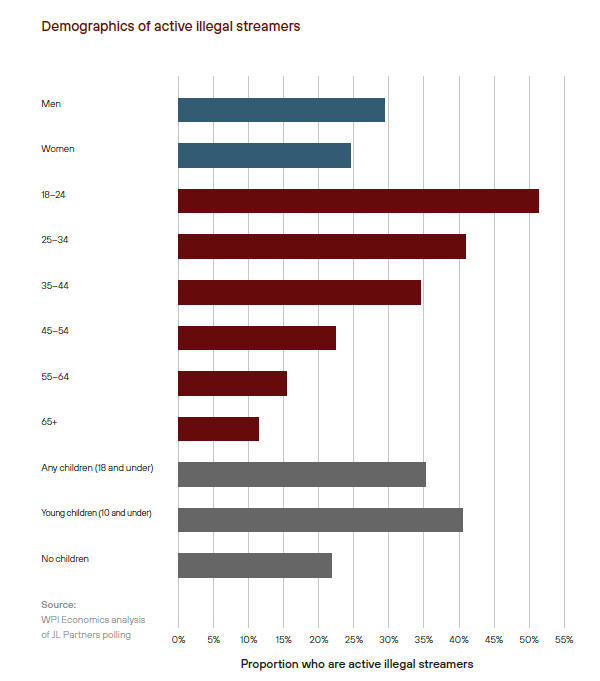
More People Illegally Stream Films and TV Shows Than Live Sports
Although piracy is often associated primarily with unauthorised broadcasts of sporting events, the UK survey paints a somewhat different picture. 88% of active illegal streamers watch films and television programmes through unauthorised sources, while 60% illegally stream live sports. Looking at individual content categories, 72% of illegal streamers watch television programmes and 69% watch films. These categories overlap, as individual viewers may consume multiple types of content. Among those who illegally stream television programmes, drama is the most popular genre, watched by 56% of respondents in this group. Comedy and entertainment programmes follow at 52%, while reality television accounts for 34% and documentaries for 32%. These findings demonstrate that digital piracy affects a broad range of television content, rather than being confined to blockbuster films or exclusive sporting events. Significant differences also emerge between male and female viewers. Among women who use illegal streaming sources, 62% watch drama content, compared with 44% of men in the same category. The pattern is reversed for sport: 63% of male illegal streamers report watching sports content through unauthorised sources, compared with just 26% of female illegal streamers. When it comes to individual sports, football is by far the most popular, watched by 91% of illegal sports streamers. Boxing follows at a considerable distance with 40%, Formula 1 with 36% and tennis with 34%. Football also maintains its dominant position when legal viewers are included in the comparison, reaching 88%, compared with 37% for Formula 1 and 34% for boxing. Similar preferences are evident among the wider viewing public, including those who access content exclusively through legal sources. Within this broader group, films are the most popular category (68%), followed by drama (60%) and comedy and entertainment programmes (51%). The findings therefore suggest that the content preferences of illegal streamers are, in many respects, similar to those of the general viewing audience.
Social Media Is the Most Common Route to Pirated Content
The analysis of how viewers access pirated content also produced some surprising results. The most common route is not dedicated piracy websites or modified streaming devices, but social media platforms. 54% of active illegal streamers access unauthorised content through social media. By comparison, 28% use unofficial websites to stream or download content, while 26% access pirated material through purchased devices or illegal subscription services. Less common methods include downloading content via torrents or cloud-based file-sharing services, used by 15% of illegal streamers, and illegally purchasing login credentials or passwords for legitimate services, reported by 7%. These methods may overlap, as users are not necessarily limited to a single way of accessing unauthorised content. The study’s authors highlight an important distinction in how different forms of piracy are perceived. Accessing content through modified devices or paid unofficial IPTV services may appear more obviously questionable to users. By contrast, watching unauthorised content on social media closely resembles ordinary everyday online behaviour. As a result, viewers may not always realise that they are accessing pirated content through these platforms.Even Some Illegal Streamers Believe Piracy Is Wrong
The research examined not only viewing habits but also attitudes towards illegal streaming. Among people who do not use illegal streaming services, 73% consider piracy ethically wrong. However, 42% of active illegal streamers share the same view. This suggests that a significant proportion of people using pirated content recognise the ethical concerns surrounding their behaviour, yet continue to engage in it. Price is one of the most important factors influencing illegal streaming behaviour. Among the reasons given for accessing pirated content, the most common is the financial advantage of illegal sources over legitimate alternatives, cited by 38% of illegal streamers. A further 31% justify their behaviour on the grounds of convenience, while 24% cite the desire to avoid subscription fees and 15% point to the limited availability of certain types of content in the UK. These responses show that saving money is not the only motivation. Ease of use and access to desired content also play important roles in shaping viewing choices. For some viewers, illegal alternatives may therefore be attractive not only because they are cheaper, but also because they appear simpler or more accessible than legitimate streaming services.
About the study: The Price of Piracy: Hidden Costs of Illegal Streaming to the UK Economy was produced by UK consultancy WPI Economics in association with the BeStreamWise initiative. The report examines the scale and nature of illegal streaming of films, television programmes and live sports in the UK, its economic consequences, the risks it poses to viewers and potential measures to tackle digital piracy. The study draws, among other sources, on a survey conducted by JL Partners among 2,501 respondents between 3 and 11 February 2026. In addition to the survey findings, it uses statistical and specialist sources, together with economic modelling, to estimate the financial and wider economic impact of piracy. Source: The Price of Pirac At the US Chamber of Commerce’s recent Digital Piracy Symposium, leaders agreed that digital piracy has evolved into a broader threat to consumers, businesses, and national security. Writing on the Chamber’s website, Jaci McDole, Executive Director, Copyright and Creativity, Global Innovation Policy Center, at the Chamber, notes that digital piracy has long been treated as a copyright problem, but suggests that Iframing is now too narrow.
“The illegal streaming site, counterfeit online pharmacy, spoofed bank email, and piracy box sitting inside a home network may look like separate problems. In practice, they are increasingly connected by the same criminal logic: exploit trusted brands, lure consumers with convenience or savings, abuse digital infrastructure, and turn stolen attention into revenue, data, and access,”she says.
“That is why the policy conversation around piracy must catch up. The question before policymakers is no longer whether piracy harms creators and rights holders. Decades of proof already exist. The more urgent question is whether our enforcement tools, legal frameworks, and public-private partnerships are built for a world where piracy functions as an entry point for fraud, malware, organised crime, and foreign actors,”she advises. As Jonathan Burks, Senior Vice President for Policy at the US Chamber of Commerce, put it: “Intellectual property is one of America’s greatest competitive advantages. Copyrights, patents, trademarks, and trade secrets fuel innovation, support millions of jobs, and enable businesses of every size to compete and to grow.” Protecting that advantage requires recognising the full ecosystem at stake. When digital theft becomes easier, faster, and more sophisticated, the costs do not stop with the company whose content, brand, or product is stolen. Consumers are exposed to fraud. Small businesses face impersonation and reputational harm. Legitimate markets lose trust. Criminal networks gain resources. Tom Galvin, Executive Director of the Digital Citizens Alliance, described the shift plainly:
“[Digital] piracy has spread from a known harm to creators to a growing harm to consumers and small businesses to a tool for state actors and terrorists to leverage to their own ends.”That evolution should change how piracy is addressed. A site offering stolen entertainment may also be a malware delivery system. A spoofed bank communication may be part of a broader brand abuse strategy. A counterfeit medicine site may be targeting vulnerable patients directly. These are not isolated violations occurring at the margins of the internet. They are business models built around deception, scale, and weak points in enforcement. Across sectors, the pattern is familiar. Criminals adapt quickly. They reuse infrastructure. They move across platforms. They take advantage of fragmented information and slow coordination. That is why a narrow, siloed response will always lag behind the threat. Fabrico Vayra, Partner at Morgan Lewis, captured the collaboration gap: “We’re all facing the same problems, usually dealing with the same infrastructure or the same sort of nexus, and we’re not talking about it, or we’re not collaborating or sharing information in a way that’s helpful to each other.” Digital crime does not respect industry boundaries, so enforcement strategy cannot be confined by them. Financial institutions, telecommunications providers, pharmaceutical companies, content creators, technology platforms, and law enforcement agencies often see different sides of the same criminal enterprise. Better information sharing, stronger relationships with investigators, and more consistent cross-sector coordination can help turn scattered signals into actionable intelligence. The same is true for government. Enforcement agencies are increasingly looking at piracy through a broader lens, including cybercrime, fraud, infrastructure disruption, and transnational criminal activity. That matters because a digital piracy operation may be difficult to prosecute through one channel but vulnerable through another. The goal should be to bring every lawful tool to bear. Anand Patel, Senior Counsel in the Computer Crime and Intellectual Property Section at the US Department of Justice, explained how the economics of these schemes can overlap: “Digital pirates are either trying to get pure ad revenue, or they’re trying to have some ad revenue, but also get some money from the cyber actors as well, so they get a cut of everyone who gets hacked through the cyber scheme.” That reality demands policy tools that can disrupt the infrastructure supporting digital crime, rather than merely punishing bad actors after consumers and businesses have already been harmed. Patel also emphasised the importance of international cooperation and operational disruption: “We’re trying to work more closely with our foreign law enforcement partners… If we can’t get the people themselves, just disrupt the infrastructure.” This is where strong public-private partnerships become essential. Companies often see the threat first. Law enforcement has authorities and capabilities businesses do not. Policymakers can help ensure that the legal framework supports timely action, effective coordination, and meaningful consequences. Ryan DiAndrea of Homeland Security Investigations noted that agents are already shifting their approach: “Agents in the field are really starting to think about digital piracy in different mindsets and how to approach these from other ways.” That mindset shift should guide the broader policy agenda. Digital piracy is no longer a side issue in the innovation economy. It is a test of whether the United States can protect the ideas, brands, products, and trusted digital channels that allow businesses to compete and consumers to participate safely online. The answer is not a single enforcement action or one new tool. It is a modern anti-piracy playbook built around collaboration, disruption, accountability, and speed, concludes McDole. Source: advanced-television.com
UK anti-piracy organisation FACT says enforcement activity over the summer has resulted in prison sentences, arrests and financial penalties against operators and users of illegal streaming services, with three recent cases involving around £1.4 million in revenue.
The largest involved Milan Ibrahim, 68, from Lancashire, who was sentenced in August to six-and-a-half years in prison after generating almost £1 million over three years from an illegal television streaming operation.
The service, initially identified by FACT and referred to the Police Intellectual Property Crime Unit (PIPCU), supplied customers in the UK and overseas, including British expatriates. A City of London Police investigation resulted in 80 streaming servers in Chorley being seized and shut down.
Content from the BBC, ITV, Sky and the Premier League was among that redistributed without authorisation.
A separate investigation begun by FACT in January 2023 identified Craig Austin, 38, of Whiston, Merseyside, as being behind a service selling unauthorised premium television subscriptions.
Austin had operated the service for more than five years and generated £205,000. FACT referred its findings to Merseyside Police in April 2025 and a warrant was executed four months later.
Austin pleaded guilty to fraud-related offences and possession of criminal property. He received a 32-month sentence, suspended for three years, together with 150 hours of unpaid work and rehabilitation activities.
In a third case, Michael Barrow was sentenced at Swansea Crown Court to three years and two months in prison after pleading guilty to three fraud offences.
Barrow continued selling illegal IPTV subscriptions and pre-loaded Fire TV sticks despite receiving a cease-and-desist notice in 2021. His service reached almost 2,000 customers and generated more than £200,000.
The prosecution was brought by the Premier League with support from FACT and the TARIAN Regional Organised Crime Unit’s Economic Crime Team.
Collectively, the three operations generated around £1.4 million.
The cases come amid continued efforts by broadcasters, sports rights holders and law enforcement agencies to disrupt the supply of pirate IPTV services rather than concentrating solely on blocking individual streams.
Research from WPI Economics commissioned by BeStreamWise estimates piracy involving sport, film and television costs the UK economy at least £1.35 billion in lost revenue annually, which it equates to 10,400 jobs.
FACT Investigations Manager Nick Sumner said the Austin case demonstrated how “intelligence-led investigations and close cooperation with law enforcement” could identify those operating illegal services and bring them before the courts.
Enforcement over the summer has extended beyond IPTV operators. FACT prosecutions involving pubs in Staffordshire and Wales resulted in licensees being ordered to pay more than £29,000 in combined fines and costs for illegally showing Sky Sports.
Investigations are also continuing in Merseyside, where four men were arrested on June 25 and 26 following intelligence-sharing between FACT and Merseyside Police. Six warrants were executed in an operation targeting suspected streaming services believed to have supplied thousands of customers.
FACT and Sky have meanwhile extended enforcement activity into Ireland. Ten suspected IPTV sellers across Carlow, Cork, Dublin, Kildare, Galway, Laois and Limerick have been served with legal warnings following joint investigations.
Cease-and-desist notices were issued to individuals suspected of supplying unauthorised access to premium television, films and live sport. The campaign also warns users of pirate IPTV services that customer information obtained during investigations may be passed to authorities.
FACT says its investigations combine open-source and human intelligence with payment information, digital trails and examination of devices. Evidence gathered by the organisation can subsequently be used to support police investigations, prosecutions or other enforcement action on behalf of broadcasters and rights holders.
Source: broadbandtvnews.comIdentifying a pirate stream, requesting its removal and taking action against its operator remain important parts of content protection. In the era of illegal live streaming, however, a purely reactive approach often comes too late. Omdia’s study Next-Generation Anti-Piracy for TV and Video: Why the streaming era demands a shift from reaction to prevention therefore recommends complementing traditional content protection mechanisms with preventive tools capable of stopping some attacks before content reaches illegal distribution channels.
Omdia’s July 2026 study points out that protection based solely on detecting and removing illegal content after it has appeared can no longer keep pace with modern piracy. The objective should therefore not be to abandon traditional protection measures, but to complement them with security mechanisms capable of stopping some attacks earlier in the content distribution chain.
Reactive protection only intervenes after an attack has begun
Anti-piracy efforts have traditionally been largely reactive: illegal content first had to be detected, followed by a takedown request and, where necessary, further legal or technical action. This approach still has an important role to play, but Omdia notes that modern forms of piracy are able to exploit its limitations. According to the study, individual traditional protection methods have their own weaknesses:
- Conditional access systems (CAS) can be circumvented, for example, through access-card cloning or key sharing.
- DRM protects digital content against unauthorized playback, but video can still be captured once it has been legitimately decrypted for viewing.
- Illegal-content takedown requests are constrained by speed: content may be republished before the original copy has even been removed.
- Enforcement by platforms, app stores and internet service providers can shut down a pirate service, but its operations may simply move elsewhere.
- Real-time monitoring of pirate streams detects theft only after it has already begun. In the case of live sports, enforcement may therefore come too late.
Each of these tools consequently has limitations that pirates can exploit. Reactive measures also face a fundamental constraint: time. Intervention only takes place after content has already begun to circulate illegally. According to Omdia, this is precisely why reactive measures need to be complemented by preventive protection.
Today’s attacks target more than the video itself
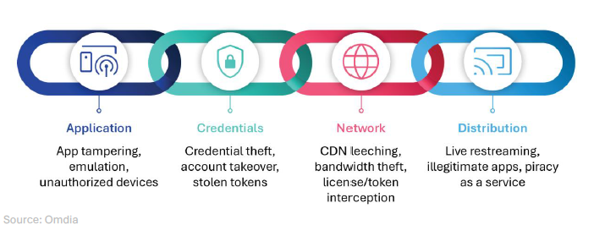
Modern piracy can target several parts of the distribution chain at the same time, including applications, credentials and the infrastructure through which content is delivered to viewers. Protecting the video itself is therefore no longer sufficient.
One prominent example is the abuse of a content delivery network (CDN). An attacker may obtain a valid access token—a digital credential authorizing access—and use it to retrieve a stream directly from the legitimate service provider’s infrastructure. Protection mechanisms must therefore verify not only whether a user is entitled to view the content, but also whether the request genuinely originates from an official, unmodified application.
image Source: Omdia
Some attacks need to be stopped before content is distributed
The fundamental shift is that service providers should not simply wait until content has been stolen and then attempt to trace and remove it. Some attacks can be stopped at the point where an attacker attempts to gain access to the content.
Omdia highlights four key elements of next-generation content protection:
- Multi-DRM – manages encryption and authorized playback across different devices and DRM technologies.
- Forensic watermarking – makes it possible to trace the source of a leak and target subsequent enforcement more precisely.
- Application security – detects and blocks unauthorized modifications to applications or the misuse of access credentials.
- Application attestation – verifies that content requests originate from a legitimate, protected application and helps prevent the misuse of credentials and distribution infrastructure.
Multi-DRM provides the fundamental layer of protection, while forensic watermarking primarily serves a reactive function. Application security and attestation, by contrast, move content protection further towards prevention.
DRM remains a cornerstone of protection, but is not sufficient on its own
Modern Multi-DRM systems make it possible to centrally manage encryption and licensing across different DRM technologies and device types. They therefore provide a fundamental protection layer in an environment where service providers distribute content across a wide range of platforms.
However, comprehensive protection must also cover the application itself, access to content and communication with backend systems.
Forensic watermarking helps identify the source of a leak
Forensic watermarking embeds identifying information into video content, making it possible to trace a specific leak back to its source. A watermark does not prevent theft by itself, but it helps determine where an illegal copy or stream originated and enables subsequent enforcement action to be targeted more precisely.
Omdia also notes that some watermarking methods have limitations, particularly in live broadcasting. Where identifying information is inserted directly by the user’s application, the reliability of the protection also depends on the security of the application itself. The individual layers of protection are therefore interconnected.
The application itself is becoming part of the security perimeter
As streaming has developed, some security functions have moved directly into applications running on devices that are not controlled by the service provider. According to Omdia, code obfuscation alone is not sufficient. Applications must also be protected against unauthorized modification and the misuse or manipulation of communications with backend systems.
An additional protection layer is provided by access control and client application attestation. The system verifies not only the user’s entitlement, but also whether the request originates from an official, unmodified application. This can help block modified applications, misuse of access credentials and unauthorized retrieval of streams from the CDN. Protection therefore intervenes before the content reaches illegal distribution channels.
Prevention is not intended to replace reactive measures, but to make them more effective
According to Omdia, preventive and reactive protection are not competing strategies. If application security and access-control mechanisms stop some attacks in advance, fewer attacks progress to the stage of illegal distribution. Reactive tools can then be deployed in a more targeted and effective manner.
The key change is therefore one of defensive logic: stop what can be stopped in advance; rapidly identify what gets through; and remove content that reaches illegal distribution channels as quickly as possible.
No security mechanism remains effective indefinitely without change
Omdia also stresses that no security mechanism can be considered permanently unbreakable. Attackers can gradually analyze DRM systems, forensic watermarking and application protection mechanisms and look for ways to circumvent them. The ability to continuously modify and renew protection mechanisms is therefore critical.
Security thus becomes an ongoing process rather than a one-off measure. The faster a service provider can update its protection mechanisms, the more difficult it becomes for attackers to repeatedly exploit a vulnerability they have already discovered.
From protecting the video to securing the entire distribution chain
Omdia’s final recommendation is therefore not based on any single technology. Service providers should assess whether their existing protection measures can withstand current attack methods—particularly CDN abuse, credential misuse and attacks targeting applications—and complement traditional reactive content-protection tools with preventive security layers. The objective is no longer simply to find and remove a pirate stream as quickly as possible. Increasingly, the priority is to stop the attack before the content reaches illegal distribution channels.
About the study: Next-Generation Anti-Piracy for TV and Video: Why the streaming era demands a shift from reaction to prevention was published in July 2026 by technology research and advisory firm Omdia. It was authored by Rob Gallagher, Principal Analyst for Consumer Technology and Services, and Rik Turner, Principal Analyst for Cybersecurity. The study was commissioned by Verimatrix and, in addition to examining how piracy is evolving in the streaming era, explores why the authors believe traditional reactive content-protection tools increasingly need to be combined with preventive security mechanisms. The analysis draws on Omdia’s ongoing research across television and online video, digital content, consumer behaviour, cybersecurity and enterprise technology. The consumer data used in the study includes an online survey conducted in November 2025 among 21,806 people aged 18–64 in Australia, Brazil, France, Germany, Japan, Mexico, Spain, the United Kingdom and the United States. Data on the reasons for using unauthorized video services is based on responses from 4,499 respondents across the same nine countries.
Source: https://www.verimatrix.com/anti-piracy/white-papers-and-ebooks/next-generation-anti-piracy-for-tv-and-video/ CANAL+ and LALIGA have signed a strategic anti-piracy agreement covering almost 50 countries across Europe, sub-Saharan Africa and Haiti, expanding their long-standing commercial relationship into a coordinated effort to combat illegal sports streaming. The agreement will see the broadcaster and the Spanish football league share intelligence, coordinate enforcement strategies and combine technology and operational expertise to tackle piracy networks operating across multiple territories. The partnership builds on CANAL+’s long-standing distribution of LALIGA competitions in France, Europe, Africa and Haiti, but extends cooperation beyond media rights into the protection of sports content. Both organisations said piracy has become one of the biggest threats to the sports industry, reducing revenues that support clubs, youth development and investment in broadcast production. They also warned that illegal streaming services expose consumers to risks including malware, fraud and personal data theft. Maxime Saada, chief executive of CANAL+, said the scale of the agreement reflected the importance the company places on tackling content piracy. He added combining the organisations’ expertise would strengthen enforcement capabilities and called on the wider sports and audiovisual industries to take similar action. LALIGA president Javier Tebas said piracy could not be tackled by individual organisations acting alone. He said the partnership would combine technology, intelligence and operational expertise to protect the value of the league’s competitions, broadcasters’ investments and the long-term sustainability of football. Source: broadbandtvnews.comThe television and streaming market continues to grow, but its economics are becoming increasingly strained. While the cost of premium content and sports rights remains high, market growth is being driven to an increasing extent by streaming models that generate lower revenue per viewer. The Omdia study Next-Generation Anti-Piracy for TV and Video: Why the streaming era demands a shift from reaction to prevention therefore warns that piracy can no longer be viewed solely as a technical or legal issue. It is having an increasingly significant impact on revenues, operating costs and the return on investment in content.
Published by research firm Omdia in July 2026, the study examines piracy in the context of the broader transformation of the economics of the television and online video market. On the one hand, service providers must finance expensive programming and premium rights; on the other, they face pressure on profitability and changes in the revenue mix. According to Omdia, it is precisely in this environment that the role of content protection is changing, moving from a supporting security function to a strategic business priority.
The economic dimension of the problem is further amplified by the profile of those consuming pirated content. Omdia points out that nearly half of the highest-spending and most engaged viewers are also among the most active consumers of pirated content. Piracy therefore has a significant impact even on audiences that are of exceptional commercial value to service providers.
The market is growing, but the revenue mix is changing
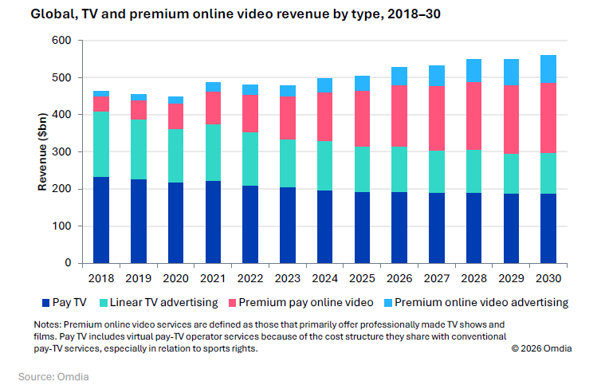
At first glance, the outlook for the industry appears relatively positive. Omdia forecasts that global television and premium online video revenues will increase from approximately USD 504 billion in 2025 to more than USD 560 billion in 2030. However, growth in the market’s overall value does not tell the whole story. It is equally important to consider where the new revenue is coming from.
According to the study, pay-TV subscription revenues and linear television advertising revenues are declining. Growth is increasingly concentrated in ad-supported streaming tiers and other online video formats, which on average generate lower revenue per viewer. The overall market can therefore continue to grow even though part of that growth comes from business models that generate less revenue per user.
The chart below shows the development of global television and premium online video revenues between 2018 and 2030, broken down into pay TV, linear TV advertising, paid premium online video and premium online video advertising.
Source: Omdia
These changes are highly relevant to the discussion around piracy. In addition to pursuing further growth, service providers are placing increasing emphasis on profitability and on their ability to monetize audiences effectively. Protecting content revenues is therefore becoming increasingly important at a time when the economics of the entire industry are under growing pressure.
Premium content still comes at a high cost
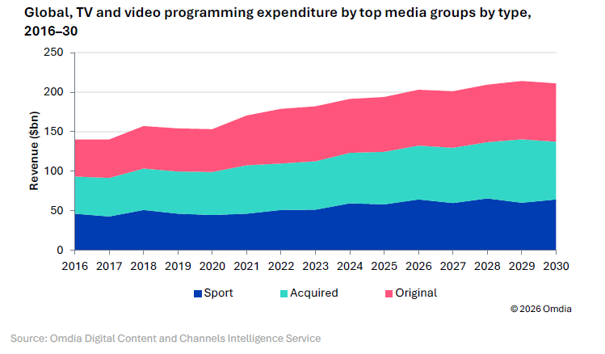
Costs, meanwhile, continue to rise. Omdia expects content spending by major media groups to reach a record USD 203 billion in 2026 and increase to USD 211 billion by 2030. Of that amount, rights to live sports alone are expected to account for USD 73 billion in 2030.
This creates a challenging combination for providers: the content they need to attract and retain viewers remains extremely expensive, while an increasing share of revenues is being generated in an environment with lower revenue per user. Piracy is therefore not only a question of content ownership, but also of whether multibillion-dollar investments in that content can generate an adequate return.
Source: Omdia
The chart shows global television and video content spending by leading media groups between 2016 and 2030, broken down into sports, acquired content and original productions. Together with the previous chart, it clearly illustrates the fundamental economic pressure facing the industry: the revenue mix is changing, while content costs remain high.
Sports are exceptionally valuable — and expensive
According to Omdia, the high level of spending on sports rights has a clear economic rationale. Sports help attract new subscribers and reduce churn. Because most sports coverage is watched live, it can also bring together a mass audience at a single moment, making it exceptionally valuable for advertising and sponsorship.
The development of sports rights prices is not uniform across all countries — growth is slowing in some markets while accelerating in others — but sports remain one of the most significant budget items for operators. This makes the impact of live sports piracy particularly acute: it affects content in which providers invest exceptionally large sums with the expectation that it will attract new subscribers and generate advertising and sponsorship revenue.
With live sports, minutes matter
Omdia identifies live restreaming as one of the defining threats of the current era of piracy. Live content is illegally redistributed in real time through pirate CTV services, social platforms, dedicated websites and apps. According to the study, this is where the financial risk is highest and where the scope for reactive intervention is most limited. By the time a takedown request for an illegal stream is issued, the match may already be over and the associated revenue lost. In this context, piracy affects the product precisely at the moment when it has the greatest commercial value to the rights holder.
When the operator also bears the cost of the pirate stream
The study illustrates the economic impact even more clearly using the example of abuse of a legitimate provider’s distribution infrastructure, known as CDN leeching. Attackers can obtain stolen access tokens from legitimate applications and use them to pull the stream directly from the operator’s network. As a result, content may be delivered to non-paying viewers through the same infrastructure that the provider finances for its legitimate customers.
According to Omdia, this type of abuse has a threefold impact. First, it increases the operator’s data delivery costs, as the provider is effectively paying to distribute content to non-paying viewers precisely during periods of peak demand. Second, the additional load may degrade service quality for legitimate subscribers. Third, it reduces the return on investment in premium content. Piracy therefore not only lowers the return on investment in premium content, but can also directly increase operating costs.
Content protection is moving from IT into strategic management
According to Omdia, the growing economic significance of piracy is also reflected in the priorities of media companies themselves. More than half of technology executives at television, film, sports and online video providers consider content protection — including technologies and measures such as digital watermarking, anti-piracy tools, application security and controls designed to limit unauthorized credential sharing — to be a highly significant business challenge.
Content protection is therefore moving onto a similar level of importance as other major issues facing the media industry, such as the adoption of artificial intelligence, cloud migration and the convergence of traditional television broadcasting and streaming. Its role is changing: it is no longer simply about securing content delivery, but increasingly about protecting revenue, content investment and the economics of the service itself.
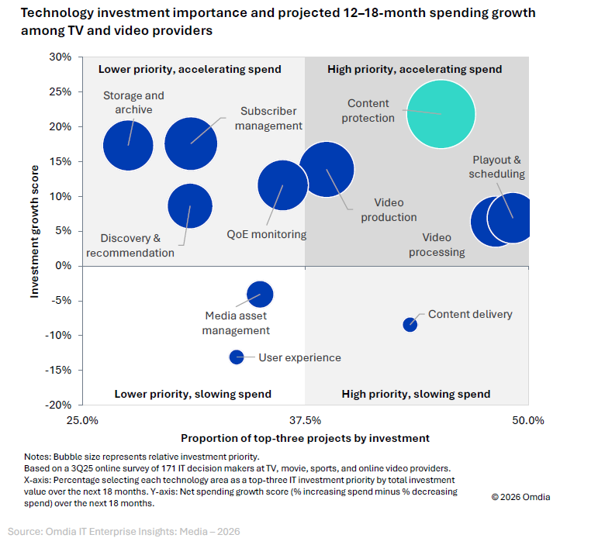
This shift is also reflected in investment plans. In a survey of 171 IT decision-makers at television, film, sports and online video providers, Omdia examined technology priorities and expected spending trends over the following 12 to 18 months. In this comparison, content protection ranks among the areas with both a high investment priority and growing expenditure. In terms of investment momentum, it ranks ahead of areas such as user experience, subscriber management, and content discovery and recommendation systems.
Source: Omdia
The chart shows that content protection is both a high-priority investment area and one in which providers expect spending to continue to increase.
Content protection is becoming part of investment protection
Against a backdrop of rising content costs, pressure on margins and pirate services that can now compete even in terms of user experience, perceptions of security are also changing. If content protection is viewed merely as a technical cost item, its business value can easily be overlooked. Omdia, however, takes a different view: content protection is increasingly also about protecting the revenue and the investment in the product for which the operator has paid.
Omdia therefore recommends that television and online video service providers treat content protection as a strategic priority. According to the study, underinvestment in this area carries the risk of losing not only revenue, but also the viewers whom investments in premium content were intended to attract and retain. From this perspective, combating piracy is no longer simply a matter of securing content; it is also about protecting the service’s business model.
According to the study, reactive measures alone are no longer sufficient. Modern piracy can exploit their limitations, and particularly in the case of live content, reactive intervention often comes too late. If revenue protection is to be truly effective, part of the defensive strategy must shift from identifying and removing illegal content after the fact to prevention — in other words, preventing attackers from obtaining the content in the first place and subsequently redistributing it. This shift from reaction to prevention will be the focus of the third part of the series.
About the study: Next-Generation Anti-Piracy for TV and Video: Why the streaming era demands a shift from reaction to prevention was published in July 2026 by research firm Omdia. Its authors are Rob Gallagher, Principal Analyst for Consumer Technology and Services, and Rik Turner, Principal Analyst for Cybersecurity. The study was commissioned by Verimatrix and, in addition to examining the transformation of piracy in the streaming era, explores why the authors believe traditional reactive content protection tools increasingly need to be combined with preventive security mechanisms. The analysis draws on Omdia’s ongoing research into television and online video, digital content, consumer behaviour, cybersecurity and enterprise technology. The consumer data used in the study includes, among other sources, an online survey conducted in November 2025 among 21,806 people aged 18–64 in Australia, Brazil, France, Germany, Japan, Mexico, Spain, the United Kingdom and the United States. Data on the reasons for using unauthorized video services is based on responses from 4,499 respondents across the same nine countries. Source: verimatrix.comBetter access to legal streaming services was expected to weaken piracy. The reality, however, has proved different. Omdia’s study Next-Generation Anti-Piracy for TV and Video: Why the streaming era demands a shift from reaction to prevention shows that more than one in five online adults use unauthorized video sources, with the share significantly higher among sports fans and the most engaged viewers. Piracy has also undergone a technological transformation: instead of complex solutions aimed at technically savvy users, illegal services increasingly offer convenience and a user experience approaching that of legitimate platforms.
Published by research and advisory firm Omdia in July 2026, the study examines one of the paradoxes of the past decade. The expansion of streaming was expected to remove one of the main drivers of piracy: content that was difficult to access or too expensive. The assumption was that if viewers could access films, TV series or sports quickly, conveniently and at an acceptable price, there would be little reason to seek out illegal alternatives. Omdia’s data, however, suggests that this assumption was overly optimistic.
The legal offering has expanded, but piracy has not disappeared
The availability of legal streaming services has indeed increased dramatically. By the end of 2025, Omdia was tracking more than 1,670 online video services across 148 countries, with more than 600 offering live sports coverage. Despite this exceptionally broad legal offering, piracy has not receded; according to Omdia, it appears to have continued growing in many countries. The sheer volume of legally available content has therefore not solved the problem on its own.
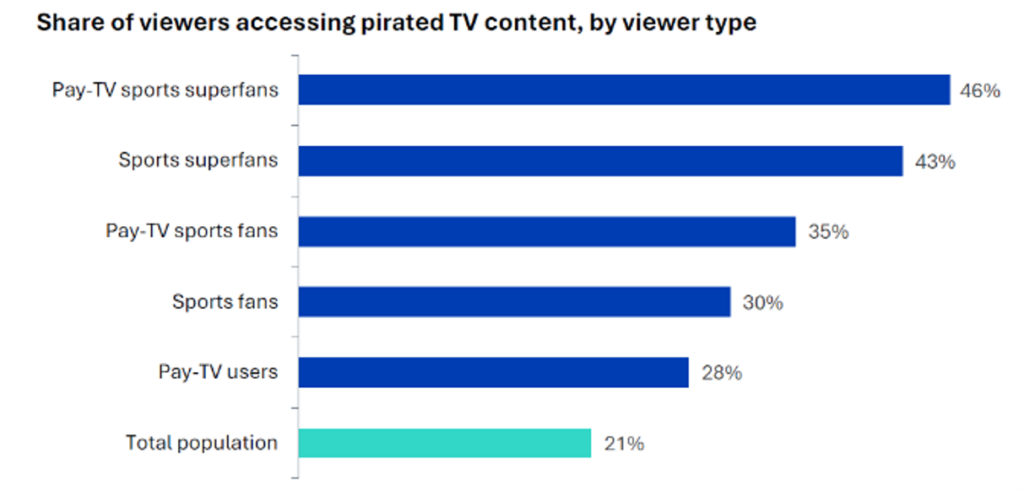
The scale of the issue is illustrated by a consumer survey conducted by Omdia in November 2025 among 21,806 people aged 18 to 64 across nine countries. Overall, 21% of online adults said they frequently stream or download video from unauthorized websites, apps or devices.
Piracy rates are highest among the most engaged viewers
The study records the highest levels of piracy among the most highly engaged audiences. Among sports superfans, 43% of respondents use pirated content, while the figure rises to 46% among pay-TV sports superfans. In other words, while roughly one in five people across the overall surveyed population use unauthorized video, the share approaches one in two among one of the most commercially valuable audience segments. Piracy is therefore not simply an issue involving viewers who are unwilling to pay for content; it also affects audiences with a strong interest in premium paid content.
image Source: Omdia
This creates a paradox: some of the most active consumers of illegal content are also among those with the strongest engagement with paid audiovisual content.
The study illustrates this trend even more clearly in the United States, one of the world’s most developed streaming markets. 29% of online adults report accessing pirated content, but among people aged 18 to 24, the figure rises to 41%. Among US pay-TV sports superfans, Omdia reports that the share exceeds 61%. Piracy is therefore not confined to consumers who refuse to pay for video. It significantly overlaps with audiences that already pay for content and are simultaneously among its most intensive consumers.
This generational dimension may have long-term implications. Younger audiences have grown up in an environment where they expect virtually immediate, on-demand access to content and, according to Omdia, have a low tolerance for friction and fragmentation in the legal streaming market. As this group gradually enters its peak earning and consumption years, the habits it forms today may influence the shape of piracy over the next decade.
Pirate services now compete not only on price, but also on convenience
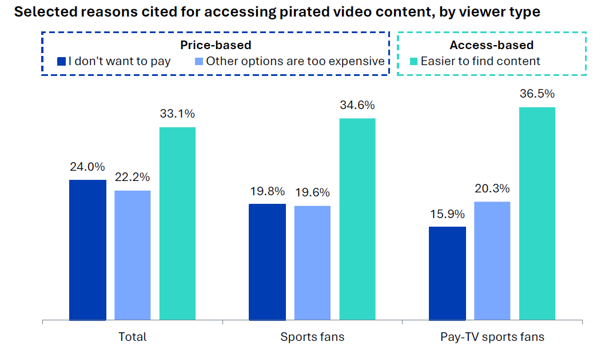
The motivations behind piracy are often oversimplified within the industry as simply “viewers do not want to pay.” According to Omdia’s data, however, the reality is much more complex. The most frequently cited reason for using unauthorized video was that content was easier to find. In a survey of 4,499 respondents who reported using unauthorized sources, 33.1% cited easier content discovery as a reason. By comparison, 24% said they did not want to pay for content, while 22.2% considered the available alternatives too expensive.
The difference is even more pronounced among sports audiences. Easier content discovery was cited by 34.6% of sports fans and 36.5% of pay-TV sports fans. By contrast, the proportion citing simple unwillingness to pay as the main reason fell to 19.8% and 15.9%, respectively. The study also notes that among sports superfans, nearly four in ten pirate viewers identify ease of access as their primary motivation. For legitimate providers, this is an uncomfortable finding: illegal services are competing not only on price, but also on the convenience with which users can access content.
image Source: Omdia
This also helps explain the apparent contradiction between the record number of legal services and the persistence of piracy. A larger number of platforms may mean a broader overall content offering, but fragmentation can also require viewers to determine which service holds the rights to a specific film, TV series or sports competition, manage multiple subscriptions and move between several different applications. The study specifically highlights younger viewers’ low tolerance for this fragmentation, while also showing that ease of finding content is one of the main advantages offered by unauthorized sources.
From hacked smart cards to smart-TV apps
It is not only consumer behaviour that has changed; the technology behind piracy has evolved as well. In the era of traditional pay television, piracy was to a large extent a hardware-based problem. Operators controlled the devices through which customers accessed content, making the security perimeter relatively well defined. Typical attacks included set-top-box manipulation, smart-card cloning or other forms of unauthorized access to broadcast signals. The emergence of new internet-based distribution technologies, however, created additional opportunities for abuse, making content protection more complex with every subsequent stage of technological development.
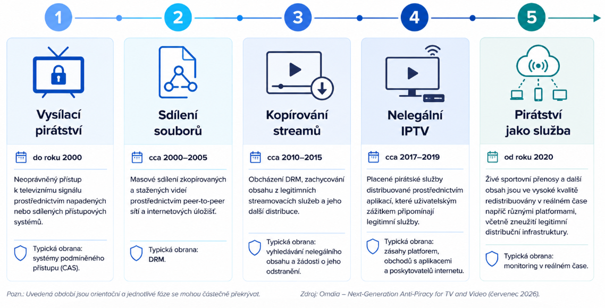
Omdia divides the evolution of piracy into several technological eras. Before 2000, a typical form of piracy involved obtaining unauthorized access to television broadcasts. Between approximately 2000 and 2005, the growth of the internet led to widespread file sharing through peer-to-peer networks and online storage services. Around 2010–2015, this was followed by DRM circumvention, transcoding and copying content from legitimate streaming services for redistribution. Towards the end of the 2010s, roughly 2017–2019, paid illegal IPTV services delivered through apps began gaining significant traction, increasingly resembling legitimate consumer products in the way they operated. The current phase, which began around 2020, is described by the study as “piracy as a service”. This means that content, particularly live sports and other events, is redistributed in real time and in high quality across multiple platforms.
image Source: Omdia
Connected TV (CTV) platforms and streaming applications have become central to this transformation. The same technology that made legitimate streaming services significantly easier for consumers to access has provided similar opportunities to illegal services. Omdia estimates that piracy through apps and devices now accounts for the majority—and a growing share—of unauthorized video consumption. The attack surface has therefore shifted from a limited number of operator-managed devices to a world of billions of devices over which content providers have no direct control.
“Streaming has transformed piracy from a hardware attack into a software-defined cybersecurity challenge.”
Rik Turner, Principal Analyst, Cybersecurity, Omdia
When a pirate service looks like a legitimate one
From the perspective of an ordinary viewer, this represents a major shift. According to Omdia, convenience, quality and an interface optimized for television screens have helped move piracy away from specialist websites and tools and closer to mainstream consumer behaviour. The study, for example, describes illegal IPTV as paid subscription services delivered through applications that provide a user experience similar to legitimate platforms. Convenience, quality and TV-friendly interfaces are therefore helping move piracy from the technological fringe into mainstream consumer behaviour.
This development also creates the conditions for one of the most problematic forms of modern piracy: unauthorized restreaming of live content. A sports broadcast or other live event can be redistributed in real time through pirate CTV services, specialist websites and apps, or social platforms. Time works against the rights holder. In the case of a film or television series, removing an illegal copy may still have value even after some delay. In the case of a football match, however, the value of enforcement drops dramatically after the final whistle. As the study points out, by the time a pirate stream is taken down, the match may already be over and its economic value to the rights holder may have been irretrievably lost.
Streaming did not defeat piracy. It helped change the rules of the game
According to the Omdia study, piracy has changed substantially since the rise of streaming services. What was once a largely hardware-oriented attack within relatively closed distribution systems has evolved into a software-based, cloud-based and multi-platform problem. And while pirated content once required a degree of technical knowledge and compromises in convenience, some illegal services can now compete with legitimate platforms in terms of user experience.
This also changes the question streaming providers need to ask themselves. It is no longer enough simply to consider whether legal content is affordable enough. The data suggests that it may be just as important to ask whether customers can easily find that content, gain access to it and watch it without unnecessary friction. At the same time, providers must contend with pirate distribution that uses the same ecosystem of applications, connected devices and internet infrastructure as legitimate streaming. Piracy is therefore becoming both a user-experience issue and a cybersecurity challenge.
About the study: Next-Generation Anti-Piracy for TV and Video: Why the streaming era demands a shift from reaction to prevention was published in July 2026 by technology research and advisory firm Omdia. It was authored by Rob Gallagher, Principal Analyst for Consumer Technology and Services, and Rik Turner, Principal Analyst for Cybersecurity. The study was commissioned by Verimatrix and, in addition to examining how piracy is evolving in the streaming era, explores why the authors believe traditional reactive content-protection tools increasingly need to be combined with preventive security mechanisms. The analysis draws on Omdia’s ongoing research across television and online video, digital content, consumer behaviour, cybersecurity and enterprise technology. The consumer data used in the study includes an online survey conducted in November 2025 among 21,806 people aged 18–64 in Australia, Brazil, France, Germany, Japan, Mexico, Spain, the United Kingdom and the United States. Data on the reasons for using unauthorized video services is based on responses from 4,499 respondents across the same nine countries.
Source: verimatrix.com